Real cute "Itsy Bitsy Spider" or "Incy Wincy Spider" entertainment and education for babies and toddlers set to music. Let a real "Smiley-Face Spider" introduce very young children to the fascinating world of real spider web building - not a cartoon. This remix of my original: Spiny Orb Weaver Spider Spinning a Web" https://www.youtube.com/watch?v=DwLn11KJS9Y was inspired by a visit to my grandnephew who at six months love to watch Youtube animal videos with music. "Itsy Bitsy Spider" vocals by the Green Orbs courtesy of the YouTube audio library.
The world's largest spider the Huge Pantropical Huntsman Spider (Heteropoda venatoria) is alive and well and living in Florida Backyards. At about 3 1/2 inches wide and 4 1/2 inches long it is the largest of the Backyard spiders I have documented. Also called a Giant Crab Spider, it is an introduced species from Asia that is now living wild in subtropical areas of Florida. Ambush hunting for large insects like Palmetto Bugs and small lizards at night. Note this one only has seven legs. They are beneficial spiders that should not be killed. More information can be found at:
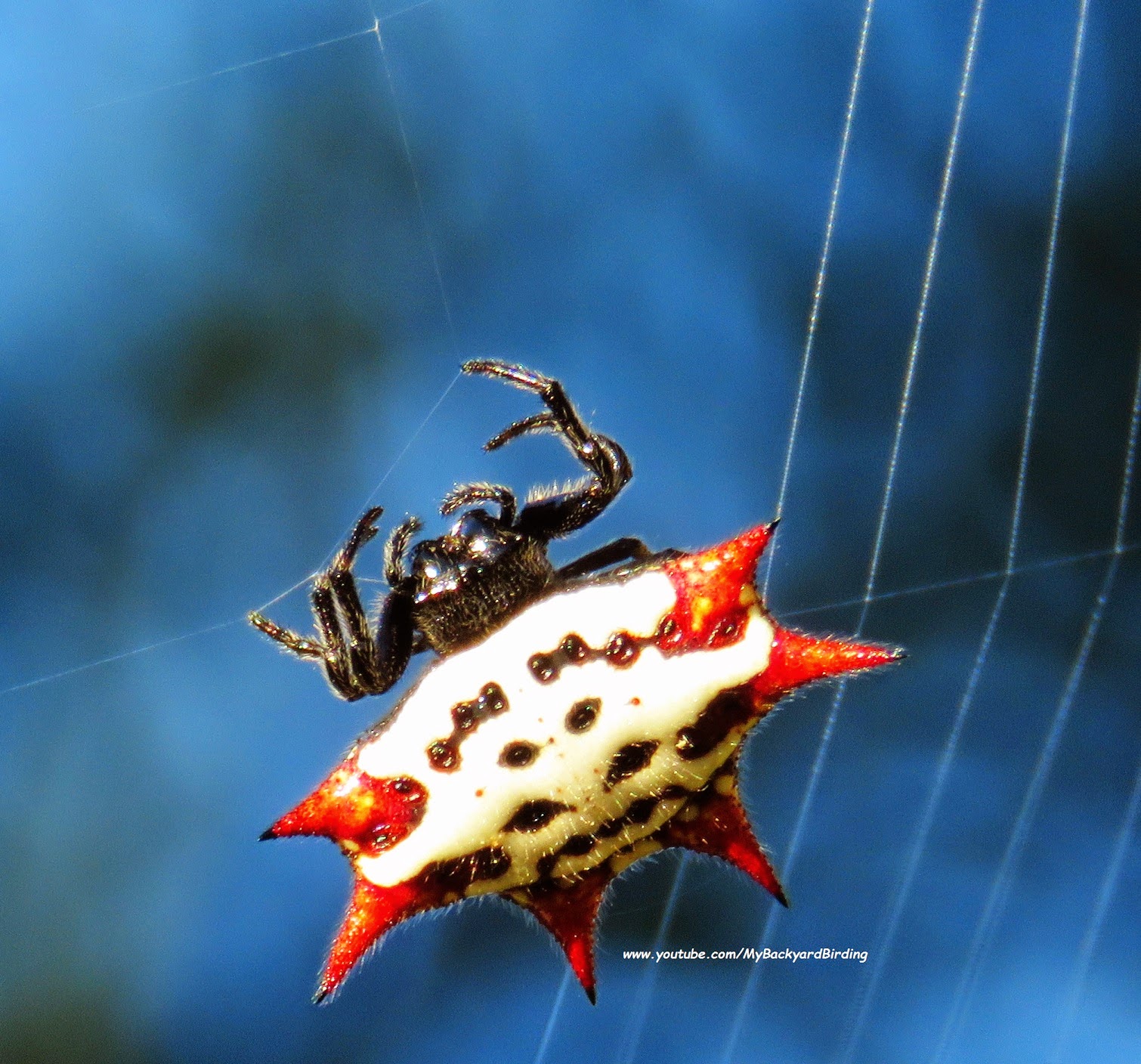
Spiny Backed Orb Weaver Spider spinning a web - one of Nature's amazing creatures. To see a video of it spinning a web check out: https://www.youtube.com/watch?v=DwLn11KJS9Y
This Orb Weaver Spider is relatively common in Florida and looks like it has red lights glowing on it for defensive purposes, Despite the appearance of two bright red triangles on its abdomen that look like at first glance like an hourglass it is not poisonous like the Black Widow - its "teeth" would have trouble penetrating human skin in any case, but it is very beneficial feasting mostly on mosquitoes and small flies.
These colorful, delicate spiders make circular webs that are usually positioned horizontally or at an angle to the ground, and they typically hang in the middle of their webs. The carapace appears yellow-green, darker on the sides. The abdomen is somewhat elongated and can be variably colored with silver, greens, yellows, reds and some blues. The legs are slender and long.
Spiny Backed Orb Weaver Spider masterfully weaving a web set to Classical Music. Because of it's stunningly bizarre beauty it is natural that the Gasteracantha cancriformis is called by many names - the star spider, spiny-backed orb weaver, spiny orb weaver spider, crab-like orb weaver spider, crab-like spiny orb weaver spider, crab spider, jewel spider, spiny-bellied orbweaver, jewel box spider, smiley face spider or sometimes in the Philippines, the king. I think of it as the happy smiley-faced spider as it really seems to enjoy its work and is a joy to have around the Backyard! Watch as this beautiful spider fastidiously works its magic set to classical music:
This is the second Marbled Orb Weaver Spider I have encountered in two weeks. This one has very unusual marbling that looks like a work of art on its back. In fact the "painting" looks a bit like Beelzebub befitting it's nickname as the Pumpkin Spider, perfect for Halloween. Its "head" is not as orange as the other Marble Orb Weaver seen two weeks ago in this video:
These spiders appeared to be in the process of dying as near freezing weather settled in. They have lain their eggs which will hatch next spring. I can hardly wait!
A little Halloween Fun.....Scary Halloween Spider set to Bach's Toccata and Fugue in D minor organ music. Crank up the volume and put this on a big screen TV and enjoy! Actually this is a very large Marbled Orb Weaver Spider that matures and turns quite orange in October and then dies - its a really sweet spider! This poor soul was picked off by a bird after I released it unharmed on a tree branch.
Orange Marbled Orb Weaver Spider in Macro - this is the perfect Halloween or "Pumpkin Spider" as it matures to a bright orange in October. Jack-O-Lantern Head and Eight big eyes staring at you - what's not to love! This one was blown out of its web onto the deck in a storm and like most Orb Weavers they are not great "Walkers" and people have nothing to fear. They are gentle spiders and quite patient while I filmed with the lens about an inch away. You can see it set a silk thread to secure itself several times so it could jump to escape if need be. This gorgeous spider was safely put back in the brush.
Black Widow behavior, female and male identification, nest or web ID and egg sac information. Black Widows are one of the most poisonous spiders in North America, but are generally nocturnal and shy and go to great lengths to avoid confrontation with people as shown in the video. Landscaping work - especially clearing yard debris - or in my case moving rocks is where one is likely to encounter these dangerous spiders. Wear gloves, pants and long sleeve shirts helps reduce the risk of a bit. Eggs sacs may be spiked as in this case or smoother. My philosophy is to let these spiders be in the wild, but to exterminate them anywhere near houses and patios. Brown Widows in my experience tend to live in closer contact with humans - liking lawn and patio furniture in particular - see: https://www.youtube.com/watch?v=1gn5lLe8cvg
All widow "webs" are messy things with debris and may look abandoned, but you can be sure the mother is hiding in a crevice nearby - and eggs sacs are a sure sign.
Brown Widow Spider Mother and her multitude of youngsters are heading out for a night of feeding. Oddly Mr. Brown Widow is nowhere to be found - - oh --- right! Poor guy. The problem is they are living in my chaise lounge - the Brown Widows are getting to be a bit of a problem these days. They love lawn and patio furniture and this is one backyard critter that I do have to dispose of. They are more toxic than Black Widows, but they are not as likely to bite or bite hard, but they have a habit of making their homes where people like to sit. Their "webs" are sloppy and often have hanging debris in them looking untidy and old or unused, but they are not. Look before you sit! I plan to do a more in-depth blog on the Brown Widows in the future - maybe it's two warm winters in a row, but they are everywhere now!
I've seen these little spiders off and on over the years, but never one in such an accesible location for filming. This little Orb Weaver was in our backyard maybe 20 feet from where I found it's huge relative The Golden Web Orb Weaver https://www.youtube.com/watch?v=7RXyYzjzZvs earlier in the summer.
But this Orb Weaver spider is only about half an inch across. It is sometimes called a "crab spider", but crab isn't what comes to mind when I see this little jewel of a spider. I don't know if it's just me and the macro lens, but the top of the spider looks a lot like a porcelain Foo Dog or Bowser from Super Mario Brothers.It appears to me to have an eastern art look to it.
The purpose of this amazing colorful deception is to repel potential predators and avoid being eaten. Far from being scary to my eye it looks a bit like a happy face with rays of sunshine. But then I don't eat spiders! Nevertheless, it is a very attractive, beneficial and entertaining little spider. In the video it eats a caught mosquito and also shows a serious aversion to vegetables, as lacking insects, I threw a small flower and piece of green leaf into its web to get it to move around - after which it quickly threw them out of the nest with an expression of obvious disdain! It seemed to be all business and fastidiously keeping a tidy web lest it miss out on a meal, it certainly had no intentions of humoring me. These spiders are small and their bite reportedly causes a very mild reaction and it is extremely unlikely that anyone would be bitten. If you see this colorful little spider let it be and enjoy!
Beautiful Golden Silk Orb Weaver Spider In Her Amazing Golden Web (Florida)
The Business Side of a Large Golden Silk Orb Weaver Spider in Florida. In part two I'll test the strength of this spider silk!
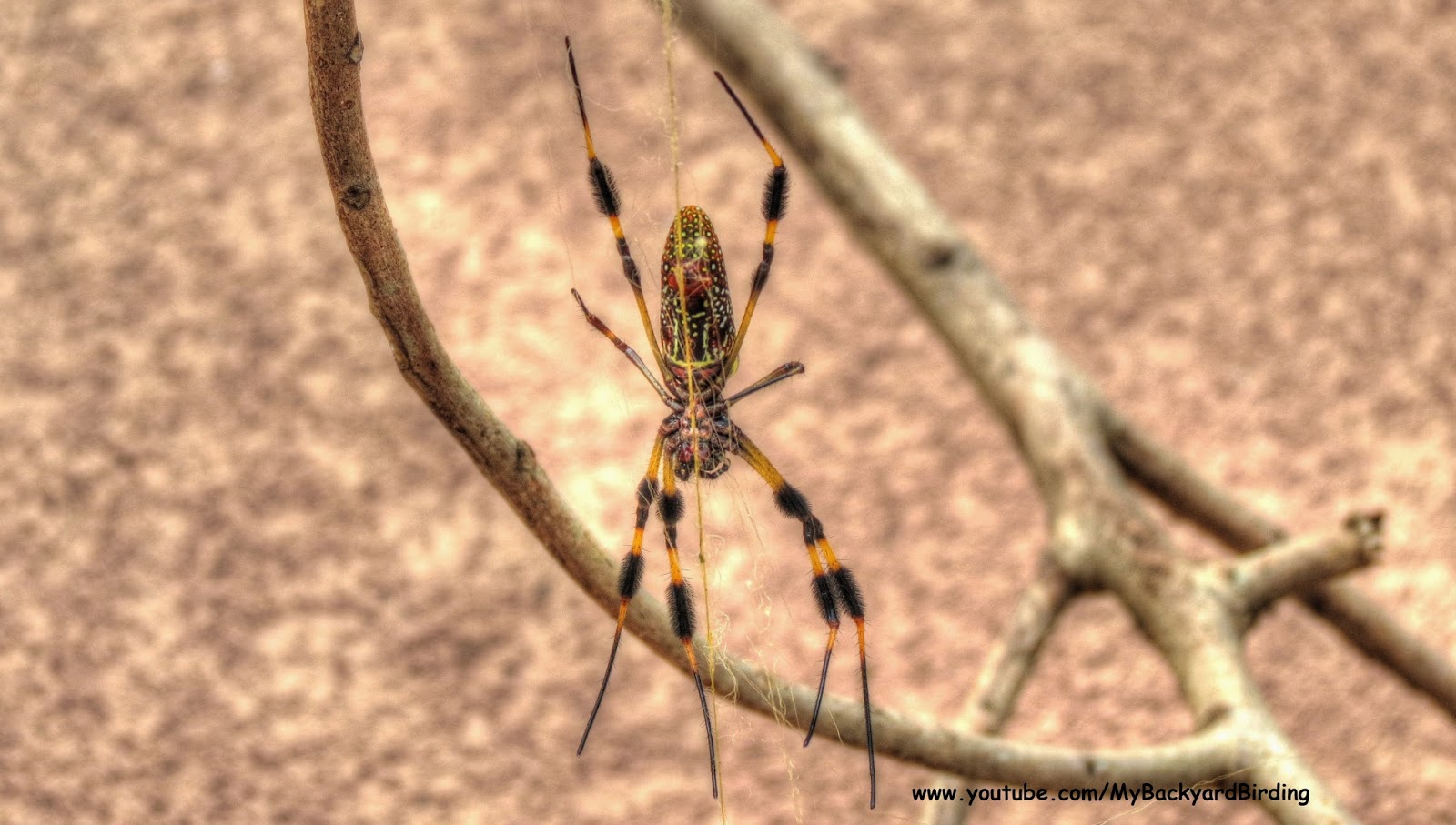
Much to my surprise a giant Golden Silk Orb Weaver Spider took up residence in our Florida backyard while we were on vacation. This 4 inch long amazing specimen is a female. The male, which I did not see, is a fraction of her size. I almost walked right into her as she perched about 5 feet off the ground in a web that was on the order of 8 feet by 4 feet, and characteristically from what I've read the web was tilted at an angle. Of course my first thought was get a video of her. As she was so docile and unconcerned by my presences that was not a problem. In the video the giant spider proceeds to do what can only be described as grooming, stretching and scratching. I guess even huge spiders get an itch now and then. She is basically just chillin' out in her amazing golden web - a spider this big has a personality!
Just as in the case of beneficial snakes these big spiders should not be killed, despite their intimidating manner they are not poisonous. I grabbed a dead tree branch and started to roll up the web kind of like cotton candy and surprisingly the big spider gathered within the web on the branch and made no attempt to run - they are not built for "running" by the way and do not like to be on solid ground where they move very slowly compared to say a wolf spider or black widow.
In the second photo above of the underside you can see the spider hanging on a large "rope" of her golden web. She stayed absolutely still and made no attempt to flee, but gave an awesome display of bio-luminescence in red, green and yellow as her only defense as "running" would be useless. After getting to know it a bit and having fleeting thoughts of keeping it as a pet - I let her go in the heavy brush behind the house where she will rebuild a golden web away from people and continue to consume large insects. Four inches long, pretty colors, bio-luminescent displays of red, yellow and green, a head that looks just like a human skull, and soft beautiful golden silk that is some of the strongest biological material on the planet - what's not to like. I kept a piece of the silk web "rope" as it was very much just like thread and in part two of this blog I give the golden silk a strength test!