Showing posts with label rabbit. Show all posts

Sunday, April 30, 2017

Desert Cottontail Rabbits


Desert Cottontail Rabbits filmed in a variety of habitats. They have many threats and Coyotes and Hawks were sighted nearby. Not too unlike the eastern Cottontail, these rabbits tend to be very wary in desert scrub habitat and more communal and social where food is plentiful and deep cover is nearby as you will see in the video.
Filmed at Merced NWR and Mojave Desert in California.

The desert cottontail (Sylvilagus audubonii), also known as Audubon's cottontail, is a New World cottontail rabbit, and a member of the family Leporidae.

The desert cottontail is found throughout the western United States from eastern Montana to western Texas, and in northern and central Mexico. Westwards its range extends to central Nevada and southern California and Baja California.[2] It is found at heights of up to 2,000 m (6,600 ft). It is particularly associated with the dry near-desert grasslands of the American southwest; though it is also found in less arid habitats such as pinyon-juniper forest.


The desert cottontail is quite similar in appearance to the European rabbit, though its ears are larger and are more often carried erect. It is also social among its peers, often gathering in small groups to feed. The desert cottontail uses burrows made by rodents rather than making its own. Like all cottontail rabbits, the desert cottontail has a rounded tail with white fur on the underside which is visible as it runs away. It is a light grayish-brown in color, with almost white fur on the belly. Adults are 33 to 43 cm (13 to 17 in) long and weigh up to 1.5 kg (3.3 lb). The ears are 8 to 10 cm (3.1 to 3.9 in) long, and the hind feet are large, about 7.5 cm (3.0 in) in length). There is little sexual dimorphism, but females tend to be larger than the males, but have much smaller home ranges, about 4,000 square metres (1 acre) compared with about 60,000 square metres (15 acres) for a male.[3]

The desert cottontail is not usually active in the middle of the day, but it can be seen in the early morning or late afternoon. It mainly eats grass, but will eat many other plants, herbs, vegetables and even cacti. It rarely needs to drink, getting its water mostly from the plants it eats or from dew. Like most lagomorphs, it is coprophagic, re-ingesting and chewing its own feces: this allows more nutrition to be extracted.[3]

Many desert animals prey on cottontails, including birds of prey, mustelids, the coyote, the bobcat, the lynx, wolves, mountain lions, snakes, weasels, humans, and even squirrels, should a cottontail be a juvenile, injured or docile.[4] Southwestern Native Americans hunted them for meat but also used their fur and hides. The cottontail's normal anti-predator behavior is to run away in evasive zigzags; it can reach speeds of over 30 km/h (19 mph). Against small predators or other desert cottontails, it will defend itself by slapping with a front paw and nudging; usually preceded by a hop straight upwards as high as two feet when threatened or taken by surprise.[3]

The young are born in a shallow burrow or above ground, but they are helpless when born, and do not leave the nest until they are three weeks old. Where climate and food supply permit, females can produce several litters a year. Unlike the European rabbit, they do not form social burrow systems, but compared with some other leporids, they are extremely tolerant of other individuals in their vicinity.
https://en.wikipedia.org/wiki/Desert_cottontail
New HD videos uploaded frequently. Subscribe at: 


Desert Cottontail Rabbits

Saturday, April 29, 2017

Black Tailed Jackrabbit


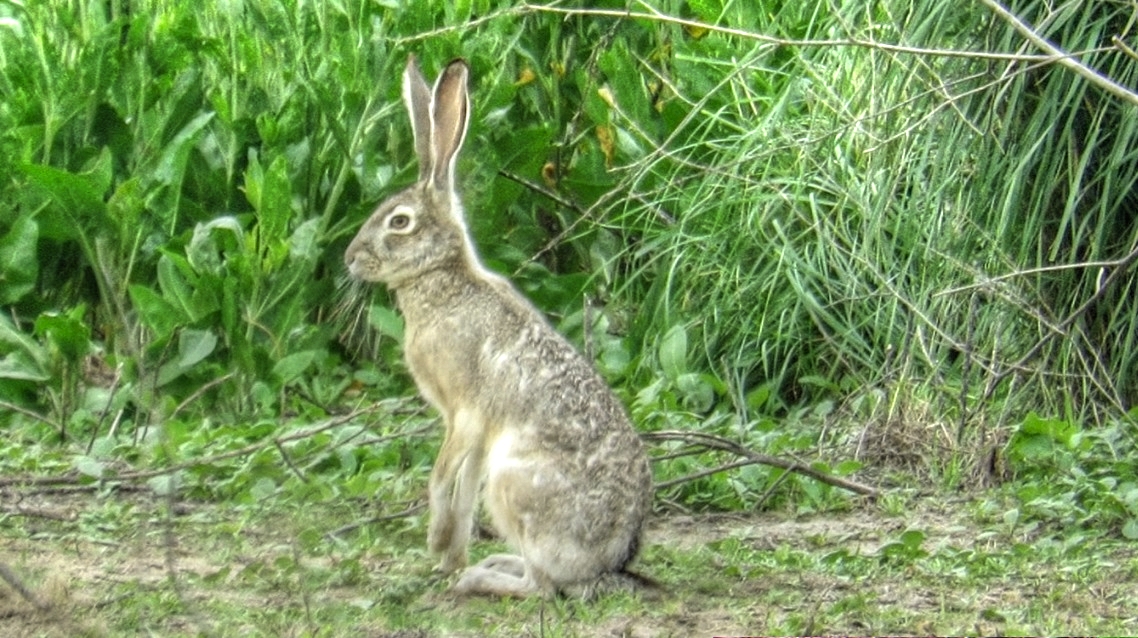
Black-tailed Jackrabbit (Lepus californicus) on the run! These large Hares have black tails and ear tips and absolutely stunning eyes! You will appreciate just how hard they are to see at the beginning of the video as they blend in with their habitat. Fortunate to have a rainstorm ending which brought out the animals in the late afternoon. Filmed in April 2017 at Merced National Wildlife Refuge, California. Enjoy!

The black-tailed jackrabbit has long ears with black tips and very long front and rear legs. It is about 18-24 inches long and weighs four to eight pounds. It has peppery brown fur and a black stripe that runs down its back. The black-tailed jackrabbit is not really a rabbit; it is a hare because its young are born with fur and with their eyes open. Males and females look alike, but females are usually larger.
The black-tailed jackrabbit can be found in the western United States from Washington south to California and east to Nebraska and Texas. It is an introduced species in Kentucky and New Jersey. 
The black-tailed jackrabbit can run at speeds of up to 30 miles an hour and it can jump a distance of about 20 feet. When it is trying to evade predators like coyotes, foxes, bobcats, badgers and weasels, it moves in a zig-zag pattern. It flashes the white underside of its tail when threatened by a predator. This warns other jackrabbits or danger and can also confuse the predator. It can also swim by dog-paddling with all four of its feet. It is most active at night. It usually spends the day resting in a scraped out hollow in the shade.
http://www.nhptv.org/natureworks/blacktailedjack.htm

New HD videos uploaded frequently. Subscribe at: 

Black Tailed Jackrabbit

Thursday, August 20, 2015

How Fast Can a Rabbit Run?


How fast can a Rabbit run – and how far can they leap? Well - pretty darn fast and far. Caught on a Bushnell Trail Camera - After a quick warm up lap this wild Appalachian Cottontail in the Great Smoky Mountains makes two amazingly fast passes and leaps in front of the camera including a classic “burnout”.  Even slowed down to 1/8 normal speed at the end the rabbit is still a blur! Not sure what real or imagined threat the rabbit is running from. Gray foxes that live here are said to be as fast as the rabbits, reaching speeds of 40+ mph, but I might put my money on the Rabbit.

New HD videos uploaded weekly. Subscribe at:
http://www.youtube.com/subscription_center?add_user=MyBackyardBirding

How Fast Can a Rabbit Run?


Tuesday, November 18, 2014

Eastern Cottontail Rabbit - Great Smoky Mountains

Eastern Cottontail Rabbit
Wild Cottontail Rabbit - Great Smoky Mountains

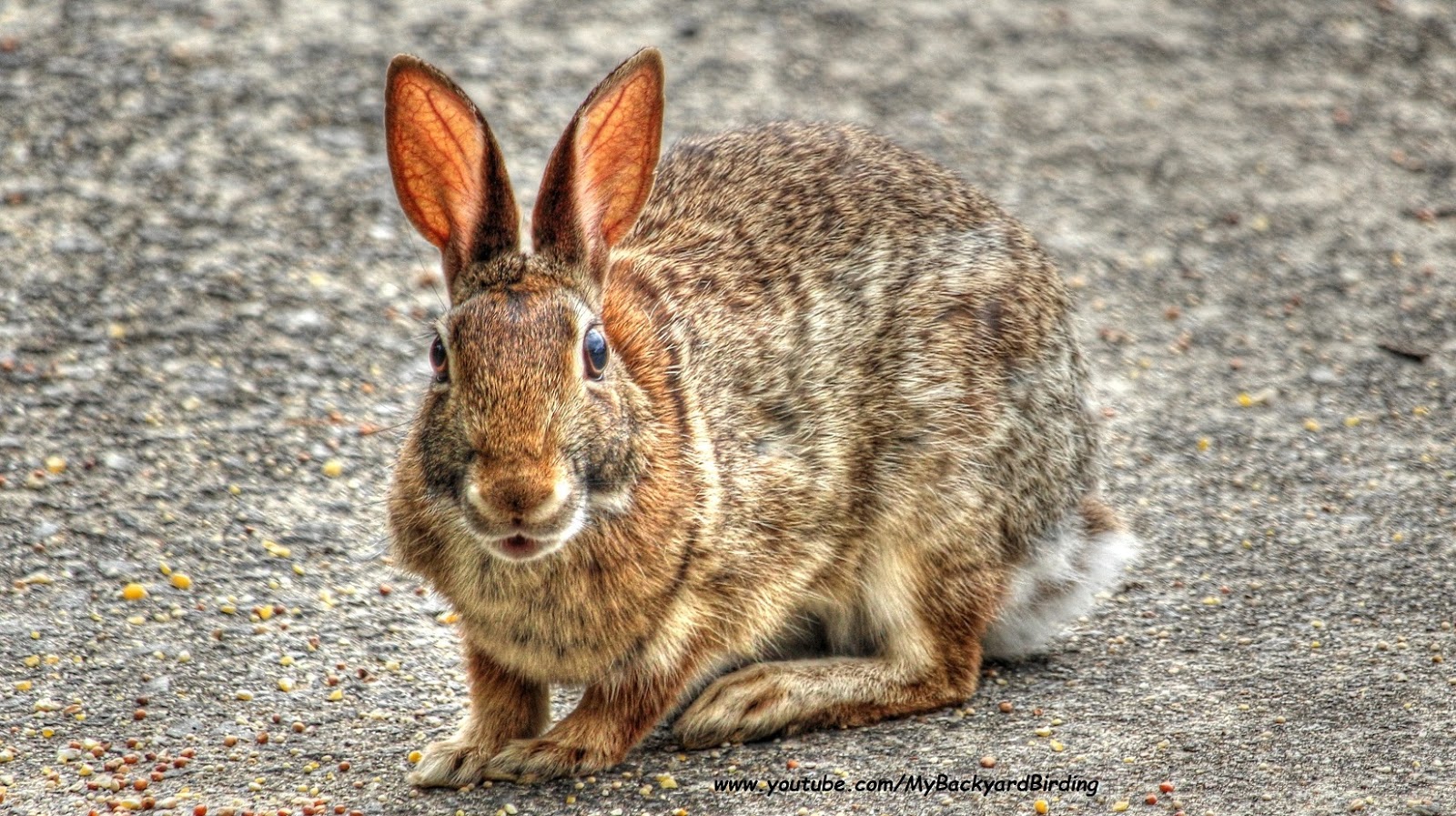
This friendly wild Eastern Cottontail Rabbit has taken a liking to birdseed. Back-lighting from the sun highlights those big ears!

Wednesday, July 30, 2014

Domestic Cat Hunts Young Rabbit


A domestic Cat i.e. someone's pet with a collar has begun hanging around my bird and animal feeding area before dawn and stalking birds and young rabbits. I like cats. It is not the cat's fault, but irresponsible cat owners that are causing the problem in these cases. This is a great use of the night vision game cameras such as the Bushnell brand I use to inventory the creatures around the backyard environment and keep track of developing problems. I'll have to track down the cats owner. Cats let loose like this might be eaten by bigger game that I've spotted with the camera in the same location such as Bobcats, Coyotes, Foxes, Dogs, Bears (perhaps), Owls, Eagles, and big Hawks or get bitten by smaller game such as rats, possums, skunks and raccoons and contract rabies, and/or otherwise get sick or injured, but they are more likely to learn to take advantage of feeding areas and hide, stalk and kill birds and small mammals. Cat's should not be allowed to roam off of their owner's property - and to reduce depredation of birds and small mammals bells can be added to their collars to lessen the chance they will successfully hunt. 

New HD videos every week. Please Subscribe at: 


Domestic Cat Hunts Young Rabbit


Wednesday, July 9, 2014

Eastern Cottontail Rabbit Grooming after Rainstorm


Wild Eastern Cottontail Rabbit high in the Great Smoky Mountains of North Carolina grooms itself with its tongue for a very long time after a thorough bath in a heavy rainstorm. No doubt taking advantage of the soaking. The picture of a well-groomed Rabbit!

New HD videos every week. Please Subscribe at: 


Eastern Cottontail Rabbit Grooming after Rainstorm

Tuesday, June 3, 2014

Relaxing Nature Meditation - Rabbit in the Rain ...


Listen to 18 minutes of thunder, rain and bird songs as a Cottontail Rabbit rides out a storm in its favorite spot under a small arborvitae tree where it has made a dirt patch. Just listen to the thunder, rain and bird songs or concentrate on the Rabbits rhythmic breathing - it's a nose breather as one might imagine. As the storm passes the birds begin to sing again and the rabbit shakes off the water and is hungry. The ebb and flow of Nature!

New HD videos every week. Please Subscribe at: 

Cottontail Rabbit


Tuesday, May 20, 2014

Cute Chipmunk Steals A Kiss From a Rabbit


A Chipmunk Steals A Kiss From a Rabbit. I starting filming this little Chipmunk who was vacuuming bird seed in a circle around the Cottontail Rabbit like a Rumba when it did the most unexpected thing and clearly steals a kiss from the Rabbit and bounds away. Slow-motion shows it clearly. Nature never ceases to entertain! Judging by the Rabbit's reaction I'm not sure the relationship has much of a future......

New HD videos every week. Please Subscribe at: 


Thursday, May 15, 2014

Wild Cottontail Rabbit Grooming


A Cottontail Rabbit picks the perfect rock to do its morning grooming and get ready for its busy day. After completing its morning grooming the rabbit demonstrates the preferred way to eat long Dandelion stems.

New HD videos every week. Please Subscribe at: 

Wild Cottontail Rabbit Grooming


Thursday, October 31, 2013

Eastern Cottontail Rabbit


An Eastern Cottontail Rabbit enjoying some grass near the Great Smoky Mountains in early October. It takes a nice long rabbit stretch at the end of the video displaying the iconic "cottontail". 

More HD videos every week. Please Subscribe at: 


Eastern Cottontail Rabbit

Eastern Cottontail Rabbit in Natural Habitat

Monday, June 24, 2013

Cottontail Rabbit Not Welcome in Red Squirrels Forest!

Video of Eastern Cottontail Rabbit chastised by Red Squirrel


This fellow has a history of outbursts - needs anger management

Eastern Cottontail Rabbit chastised by Red Squirrel

Who could not love a bunny rabbit? - our typically irritable Red Squirrel for one! This rabbit chose to rest under the Red Squirrels favorite tree and the squirrel threw one of its classic rants. The Eastern Cottontail being a somewhat mellow creature took it in stride and even relaxed and cleaned itself up in front of the squirrel adding to its bad mood :-)

More HD videos every week. Please Subscribe at: 
http://www.youtube.com/subscription_center?add_user=MyBackyardBirding